


Before You Spend Another Dollar on Marketing, Do This First.


I was talking to a dental marketer last week who was genuinely frustrated.
He'd been running a strong campaign for a dental practice, good ads, solid targeting, healthy metrics. But the doctor was calling him every week, convinced the whole thing wasn't working. "We're not getting any phone calls," the doctor kept saying.
So the marketer dug in. He pulled the call tracking data and found something that stopped him cold: the calls were coming in.
A lot of them.
The campaign was doing exactly what it was supposed to do.
The problem was the practice's appointment scheduling software hadn't been configured correctly. Every call was arriving and disappearing into a digital void. The front desk never knew they were coming. The practice had been paying for marketing, generating real interest from real patients, and missing every single one.
I've been thinking about that story all week.
It's not really a marketing story. It's a systems story. And it's one I've seen play out in different forms across hundreds of practices over the years.
Systems First: The Real Reason Your Marketing Isn't Working
Before you can market effectively, your practice has to be ready to receive patients. That sounds obvious, but it's remarkable how often it isn't true.
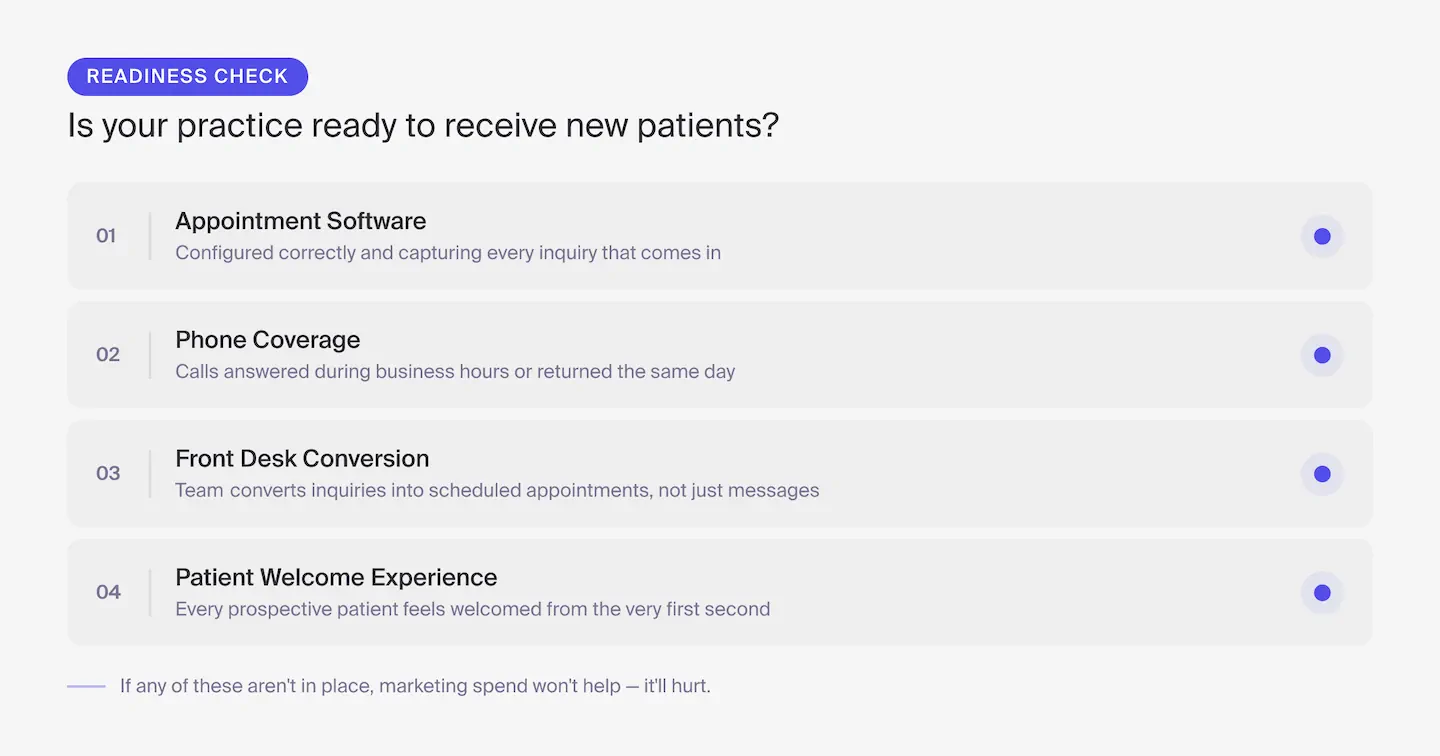
Here's what "ready to receive" actually looks like:
- Your appointment software is configured correctly and capturing every inquiry.
- Your phones are answered during business hours, or calls are returned the same day.
- Your front desk team knows how to convert a new patient inquiry into a scheduled appointment, not just take a message.
- And when a prospective patient calls, they feel welcomed from the very first second.
If any of those four things aren't in place, marketing spend won't help you. It'll hurt you.
Not because the campaign is bad, but because you're paying to generate interest you can't capture.
The practice in the story wasn't just losing money on ads.
They were also losing the trust of patients who called, got nothing, and moved on to the next practice. That damage is harder to measure, but it's real.
Here's the harder question to sit with: some practices have a conversion problem they've never diagnosed. They assume the phone isn't ringing because the marketing isn't working. But the phone might be ringing just fine, and the calls are getting lost, mishandled, or never followed up on.
Before you evaluate your marketing, look at your systems.
What actually happens when a new patient calls right now? Can you trace that inquiry from first contact to booked appointment?
If not, that's where the work starts, not with the ads.
Nail the Basics Before You Pay for Traffic
Once your systems are ready to receive patients, the next question isn't "what should I advertise?" It's "am I getting everything I can from what's already free?"
Two channels consistently outperform paid advertising for dental practices. Most owners underuse both of them.
Your Google Business Profile
This is the most valuable piece of digital real estate most practices never pay enough attention to. When someone searches "dentist near me," or your practice name directly, your Google Business Profile is often the first thing they see. It either builds confidence or creates doubt.
A well-maintained profile has recent reviews and genuine responses to those reviews. It has up-to-date hours, photos of the office and team, and answers to common patient questions. A neglected profile has a handful of old reviews with no responses, and a photo from several years ago.
The difference matters more than most owners realize. Most prospective patients make a decision about whether to call before they ever visit your website. They're judging your practice from that profile page in about 30 seconds.
Bringing your Google Business Profile up to standard costs nothing but time and attention. It's the first place to start.
Patient Referrals
Word-of-mouth is still the number-one source of new patients for most dental practices, but most owners treat it as something that just happens, a passive byproduct of doing good work.
It is a byproduct of doing good work. But it doesn't have to be passive.
Having a simple, natural system for asking happy patients for a referral, or a Google review, is one of the highest-return investments you can make in your practice.
Your team doesn't need a script that feels awkward or salesy. They just need to know that asking is encouraged, and to recognize the right moment to do it.
In working with practices across the country over many years, the ones with the strongest consistent new patient flow almost always have a referral culture, where asking is normal, expected, and celebrated when it works. That culture doesn't cost anything to build. It just requires intention and a little training.
Get these two things working well, and you have a real foundation. Then, and only then, does it make sense to think about paid marketing.
Paid Marketing: What Works, What to Watch, and How to Hold Vendors Accountable
Once your systems are solid and your free channels are producing, paid marketing can be a meaningful accelerator.
But it's also easy to spend a significant amount of money and have very little to show for it.
Here's what I'd tell any practice owner thinking about going this route.
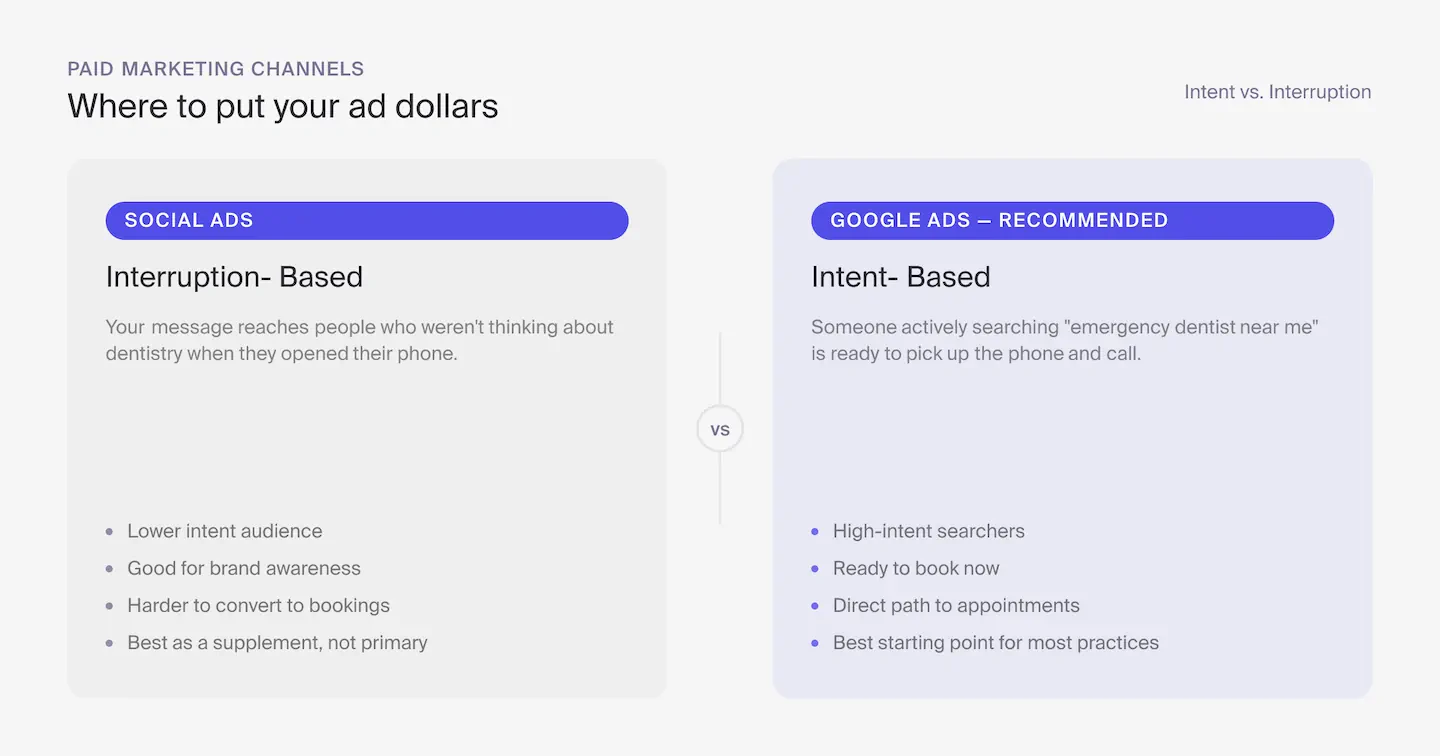
Google Ads tend to outperform social ads for dental practices
The reason is simple: intent. Someone searching "emergency dentist near me" or "Invisalign [your city]" is actively looking for a dentist and ready to call. Social media advertising puts your message in front of people who weren't thinking about dentistry when they opened their phone, which isn't worthless, but it's a harder conversion. For most practices, Google is the right place to start.
Budget matters more than most agencies will tell you
There's a floor below which most paid campaigns don't generate real results. Spending $300 to $400 a month on Google Ads in a competitive market usually isn't enough to learn anything useful, let alone drive consistent bookings. Before you commit, ask your vendor directly: "What's the minimum viable budget for my market and specialty?" If they can't give you a straight answer, that's worth knowing.
The only metric that matters is booked appointments
Impressions, click-through rates, cost-per-click, these are useful data points, but they are not the point. If your agency is sending you monthly reports full of those numbers without connecting them to actual appointments scheduled, ask the question plainly: "How many new patients can you directly attribute to this campaign?" A good vendor should be able to answer that. If they can't, you don't have enough information to know whether you're getting value.
And this brings everything back to where we started. Even the best-run paid campaign is only as good as the system waiting to receive that patient at the end of it. Great ads sending calls to a misconfigured phone system is just an expensive version of the problem we talked about at the top.
The Right Order Makes All the Difference
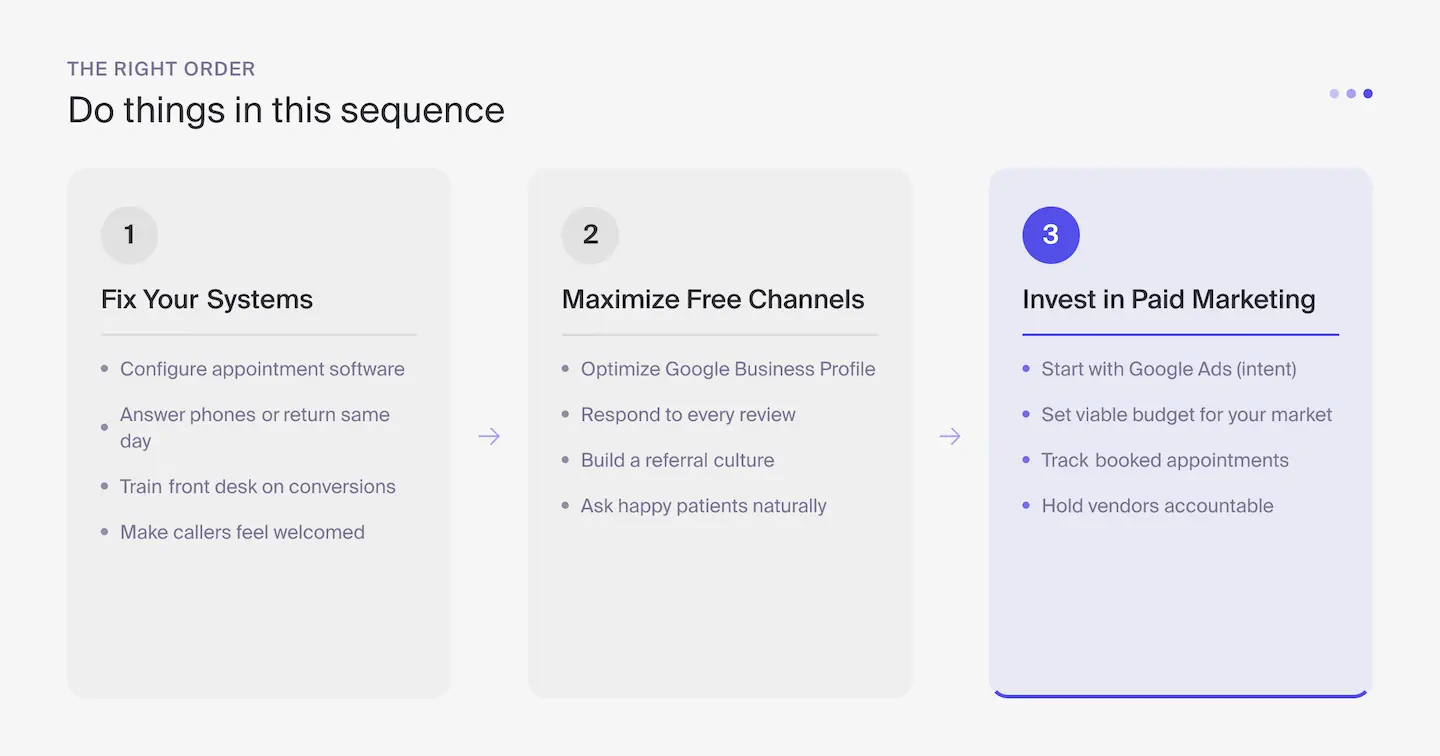
None of this is complicated, but it does require doing things in the right sequence.
- Systems first.
- Free channels second.
- Paid marketing third.
Practices that work in this order tend to grow steadily without burning through marketing budgets chasing results that their own intake process would have undermined anyway.
And steady, consistent growth matters beyond just this month's new patient numbers. When the time comes to eventually transition or sell your practice, production trajectory is one of the most important factors in how your practice is valued, and how willing banks are to finance a buyer. A practice with a strong, consistent new patient flow commands a better price and a smoother transaction.
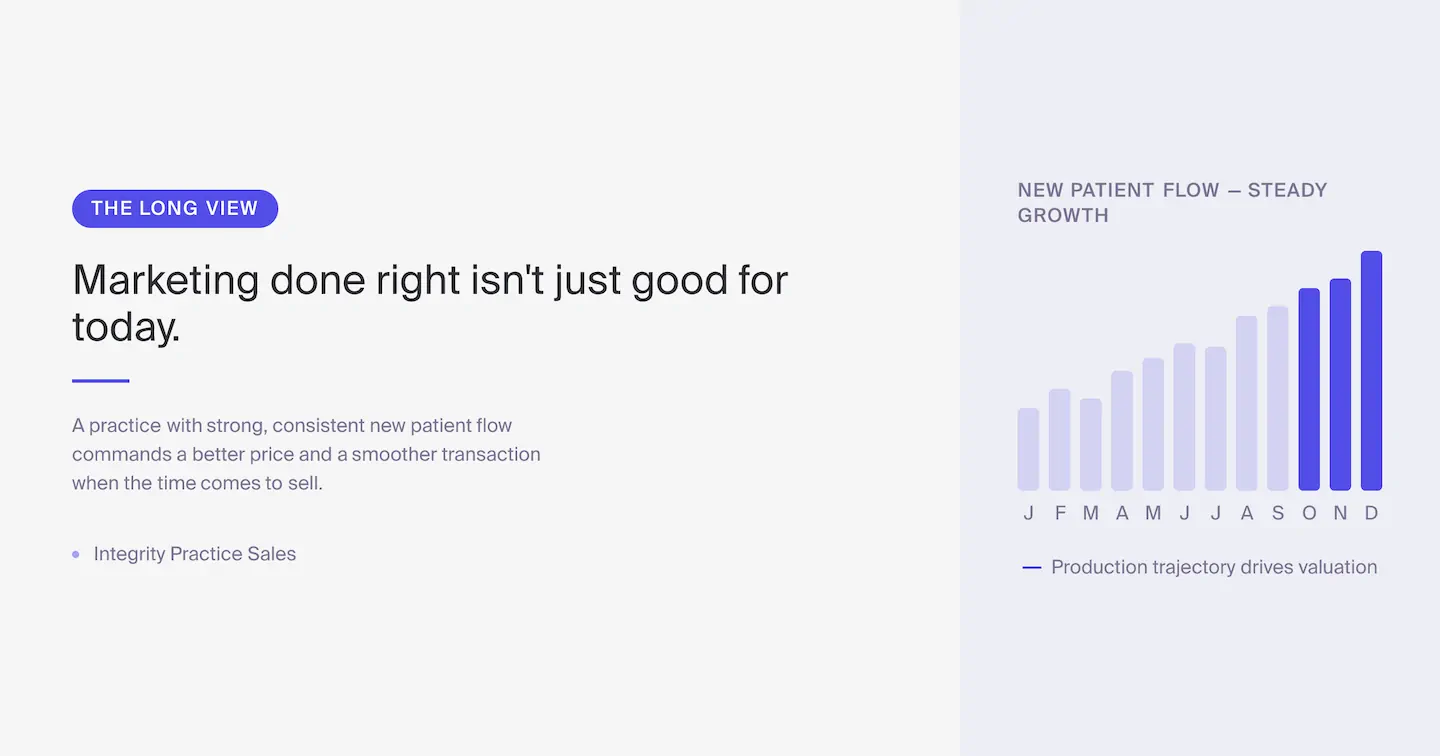
Marketing done right isn't just good for today. It's part of building a practice worth owning for the long term, and worth selling when the time is right.
If you're curious where your practice stands, whether you're thinking about growth, a future partnership, or an eventual sale, we're always happy to have a conversation.
Reach out to the team at Integrity Practice Sales. There's no pressure and no obligation, just an honest look at where you are and where you're headed.

Ready to Navigate Due Diligence Like a Pro?
If your practice could be worth $1.3M, don't settle for $900K.
Most dentists discover these problems during negotiations—when it's too late to fix them. We're sharing the 10 hidden value killers that cost practice owners hundreds of thousands of dollars in our free guide: "The (Multi-)Million Dollar Practice Exit."

Keep reading more helpful content from our team.


Selling a Practice
How Much Is My Practice Worth?

Buying a Practice
How to Buy a Dental Practice: The Complete 2026 Guide

Practice Management
Demystifying Dental PPOs: How to Put More Money in Your Pocket (While Doing the Same Dentistry)